When Hurrahs Turn to Hoots
Matthew 3: 1-13
December 3, 1995
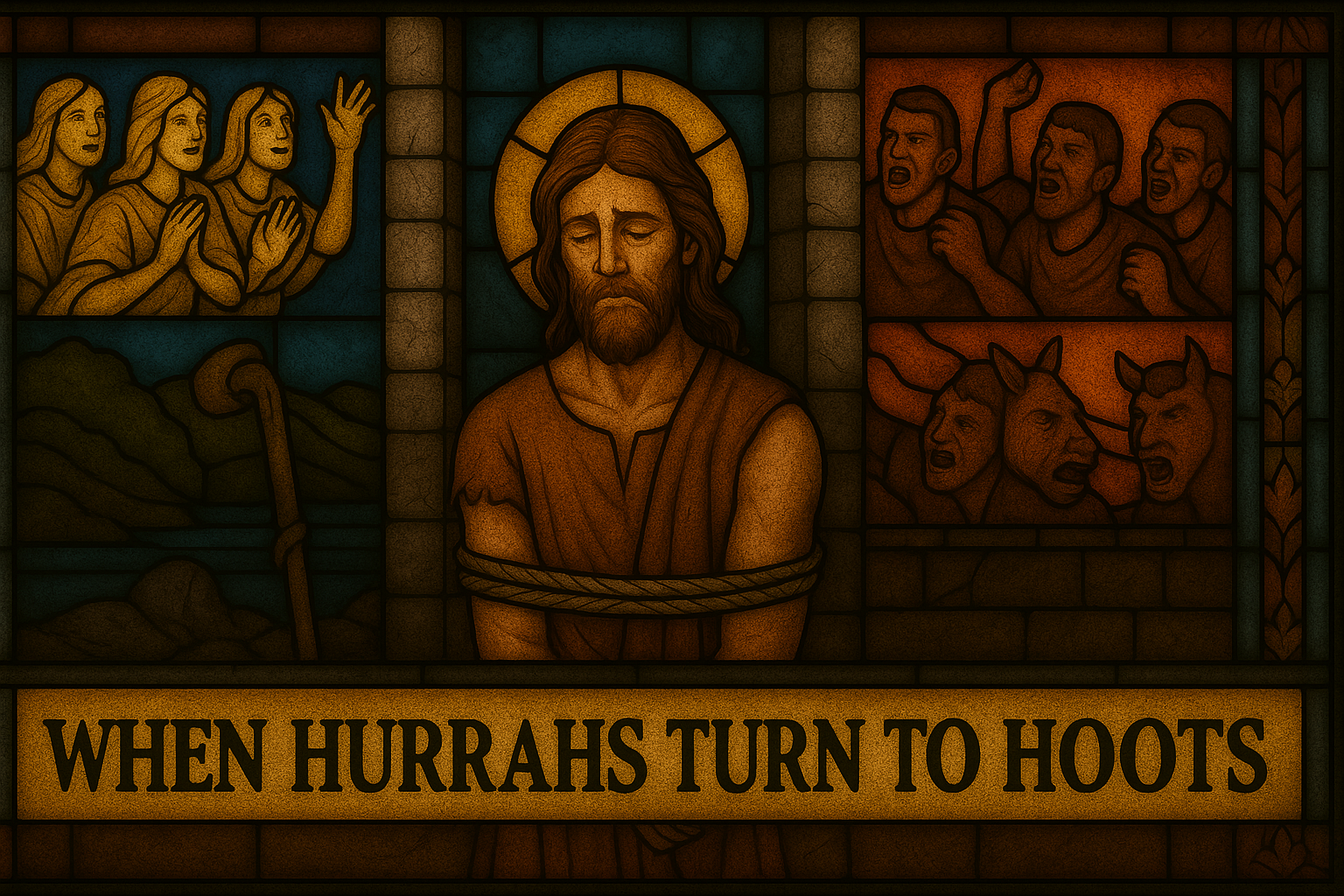
How quickly the hurrahs of today become the hoots of tomorrow. John, our central character today, was a great success as a traveling preacher, but he ended up at the king’s birthday party looking like a piece of sliced turkey with his head severed from his body.
Most of us know John’s story. At first, when he began to preach, great crowds gathered. His message was fairly direct and simple. Repent. Change your way of life. Become clean. Look after the poor, the neglected, the outcasts. Take from the rich and give to the poor. John was in the prophetic tradition. He represents the time-old message: “Clean up your act. You who are supposed to be the Chosen people. Repent!”
John was forceful. He was like old-time preachers who were under a tent. He had a booming voice, an electric delivery, and a charismatic personality.
Listen to how Fred Buechner describes him. “John the Baptist didn’t fool around. He lived in the wilderness. . . subsisted on a starvation diet. . . wore clothes that even in a rummage sale people wouldn’t have handled. When he preached, it was fire and brimstone every time.”
The Kingdom was coming all right, he said, but if you thought it was going to be a pink tea, you’d better think again. If you didn’t shape up, God would give you the ax like an elm with the blight. He said that being a Jew wouldn’t get you any more points than being a Hottentot, and one of his favorite ways of addressing his audience was as a snake pit. Your only hope, he said, was to clean up your act as if your life depended on it, and get baptized in a hurry as a sign that you had. Some people thought he was Elijah come back from the grave, and some others thought he was the Messiah, but John would have none of either. “I’m the one yelling myself blue in the face in the wilderness,” he said, quoting Isaiah. “I’m the one trying to knock some sense into your heads.”
After a while, John’s message became redundant. And crowds are so fickle. His congregation dwindled, and then one day he made some comments that had political overtones. And, as every preacher knows, you can’t mix religion and politics, or so those who disagree with us are always saying. And every preacher knows you had better not criticize the people in power unless you have a job waiting for you in another town. John’s story ends with his being tossed in jail for subversion and later being executed at the king’s party. How quickly the hurrahs became hoots and cheers became jeers. John the charismatic is soon forgotten. Just another dead prophet. Someone who bursts upon the scene attracts a following and, in a few short years, is abandoned, irrelevant, and redundant.
Where is God for those who have lost their following? Where is God for those who had it made in the past, but are now devalued, unnecessary, redundant? Where is God for the people who walk confidently toward the open door, but find it closed before they are ready to go through it? Where is God for the people who skate along toward a bright future and eventually find the solid ice has cracked under their feet? Where is the God of John the Baptist?
Jesus taught that the concern of God is riveted on the Johns of the world. Do you remember the Beatitudes? it describes how God cares most for those who are poor in spirit, for those who are persecuted, for those who have been abandoned. Is this not John the Baptist? is this not all of us who have suffered the slings and allows of outrageous fortune? Who have been relegated to the sidelines in life?
I remember once going to talk with a spiritual director when I was feeling depressed. I recall saying how lousy life was treating me. How I had been one of the comers in the church, one of the successful cardinal rectors – treated with a certain adulation, asked to preach, and to talk on how to grow a church. But after I’d hit the mid-50s, I suddenly became old hat. What had been hot in the 80’s became stale in the 90’s. And I recall sharing this with my friend, and saying that I felt abandoned by the church.
He listened to my tale of woe and said, ‘You know the two most important words of Scripture are: ‘And Yet.’ I don’t want to minimize your feelings,” he said, ‘but you can look at your situation realistically and then say: ‘And Yet”
And yet, there is something here that God can use.
And yet, isn’t our God a God who picks up the pieces, finds the lost sheep, breathes new life into dead bones, has a future beyond what we might imagine?
It’s good for us to focus on John the Baptist this morning. Not because of his contribution to the Christian story, although the church has always listed him as the Advent Saint, the one who prepares us for receiving the Christ Child. No, it’s good to focus on John for his life shows us the importance of persevering even when the even the hurrahs turn to hoots, the cheers to jeers. Even in prison, when John might have thrown in the towel, John continued to search for what it was that God wanted. You might remember that he even sent one of his few remaining disciples to Jesus, in order to find out if He were the promised one. John’s message might have been dated and redundant, but at the same time, John was able to say:
“And Yet.” And yet God still could use him as the herald of the Christ Child.
Let me end this sermon on John the Baptist by quoting a story that Ken Blanchard shares in a little book that he wrote as a Christmas present to his wife. In the preface, he says, ‘I needed to write this book as much for me as for you.
There was a rabbi who went to live in a corrupt city. Every day, he ran through the streets of the city and shouted over and over: ‘Repent! Turn from your sins. Repent! Turn from your sins.’ Days led into weeks, and weeks led into months, and months led into years.
Every day, the rabbi could be heard shouting his plea. Finally, one day a friend asked the rabbi, ’No one listens to you anymore. Everyone is laughing at you. Why do you continue to do this?
The rabbi was quick to reply. When I first came here, I dreamt of a city turned toward God. I envisioned the city changing. That has not happened, so today I run through the streets shouting my plea to keep the city from changing me.
We have all been there – when the future seems denied, when all the hurrahs have turned to hoots. Can you join John the Baptist and keep preparing for the one who is to come? Are you able to say: “And Yet?” “And yet God continues to use me.” AMEN.
When Hurrahs Turn to Hoots
When Hurrahs Turn to Hoots
December 3, 1995
Scripture: Matthew 3: 1-13