“What Ought I to Do?”
Matthew 25: 1-13
October 22, 1995
I have a recurring nightmare. It’s Sunday morning, and the church is full. I step into the pulpit to preach – look down at the lectern and there is nothing there – no manuscript, no notes, and my mind is a blank. I’ve forgotten everything, and I just stand there, not knowing what to do or say
A psychiatrist might interpret the dream as a normal stress-related occurrence. But I suspect it’s something more. I believe it’s a way that my subconscious is raising one of Kant’s three basic questions of life. The question, ‘What ought I to do?”
We are exploring in this series Immanuel Kant’s three questions, with which he said all mature persons must grapple throughout their lifetime. The questions are: “What can I know?”; ‘What ought I to do?’; and, “What is my hope?”
It seems risky to focus on a question that involves behavior at this time in our parish life. Many of us are focused on the canvass and pledging. And this makes people edgy, particularly when a clergyperson tackles questions like: ‘What ought I to be doing?” But be that as it may, let’s turn to Holy Scripture and see if we can get some help on one of life’s basic dilemmas. WHAT OUGHT I TO DO?
The Bible has three principles that are embedded in book after book. They come up in different ways from Genesis to Revelation. The first is found right at the start with Adam and Eve, and is a central affirmation of all the writers of Scripture. Humankind has been given a gift by God. It is both a terrible burden and a wonderful gift. It is the gift of freedom – the freedom to choose, the freedom to change, the freedom to do many things in many different ways. Certainly, there are limitations. Our backgrounds, age, physical stature, and many other factors introduce limits on our freedom. But basically, within certain parameters, we all enjoy the terrible and wonderful Gift.
Let me share a secret. Seven out of ten people who come to me for counseling do not really believe they have this gift. They come because they feel stuck, unable to see alternatives to what they are presently doing. My task, as I see it, is to help people discover alternatives, to understand that they have been given the gift of freedom, to learn that they don’t have to act in the way they have always acted.
A friend tells the story of how he first learned to appreciate this gift. He arrived in Southern California fresh out of seminary. He had gone to establish a church. He had written and called friends and had been led to believe that he could start immediately, preaching and starting his congregation at the local high school on Sunday. And so he landed with his wife and all his worldly goods. And there he was sitting in an apartment on Thursday, brushing up on his sermon – and he got a phone call from the school board informing them that they could not use the premises of the local high school. My friend says he was discouraged, downhearted, ready to throw in the towel, prepared to pack up and go back to Chicago. He felt stuck and defeated. As he sat there with his wife at the dining room table, he picked up a pen and began to doodle on a paper napkin. Suddenly, he found himself writing down ten alternatives. And that’s when it dawned on him that he had been given a gift – the freedom to choose. He didn’t have to be stuck or limited by the circumstances of the school board. So, remember this, if you don’t remember anything else in this sermon: You don’t have to do things the way you have always done them. The Bible reminds us that we have been given the gift of freedom.
The second affirmation from scripture is less clear, yet just as important. This is the principle that says: ‘We are accountable.” Accountable for what we do, accountable for our choices, accountable to God.
I guess that most of us have been taught a lot about being responsible, but very little about accountability. There is a difference. It’s a subtle difference, but extremely important. To be responsible means literally “to be able to respond.” Responding to a need or concern is what any good citizen or good neighbor would do. As a matter of fact, if someone were to call us irresponsible, we would take it as a large insult. Being responsible is a high value.
The problem is that it’s a societal value and not a Christian virtue. The virtue that Scripture enjoins us to follow is to be accountable. As the people of God, we are accountable to God for all our actions, decisions, and for all that we do. This means that our every action has meaning far beyond any given situation. Every choice, everything we do, says a great deal about who we are and what our ultimate allegiance is. Thomas Merton, the great monk, spiritual leader, and writer, put it this way. “If you want to know who I am, don’t simply ask me what I do or where I live. Ask me to whom I am accountable and for whom I am living. And then push me on it.”
The third Biblical principle is that living the Godly life means to live as if each moment were your last, your final testament.
Now let/s look closely at the implications of this principle_ To live as if each moment were your last would mean that we would be living in a constant state of readiness. We would be living our life in a crisis mode for our every action would have eternal significance.
Most people do not care to live that way. A sense of urgency is not the kind of message we’re looking for on a beautiful Sunday morning.
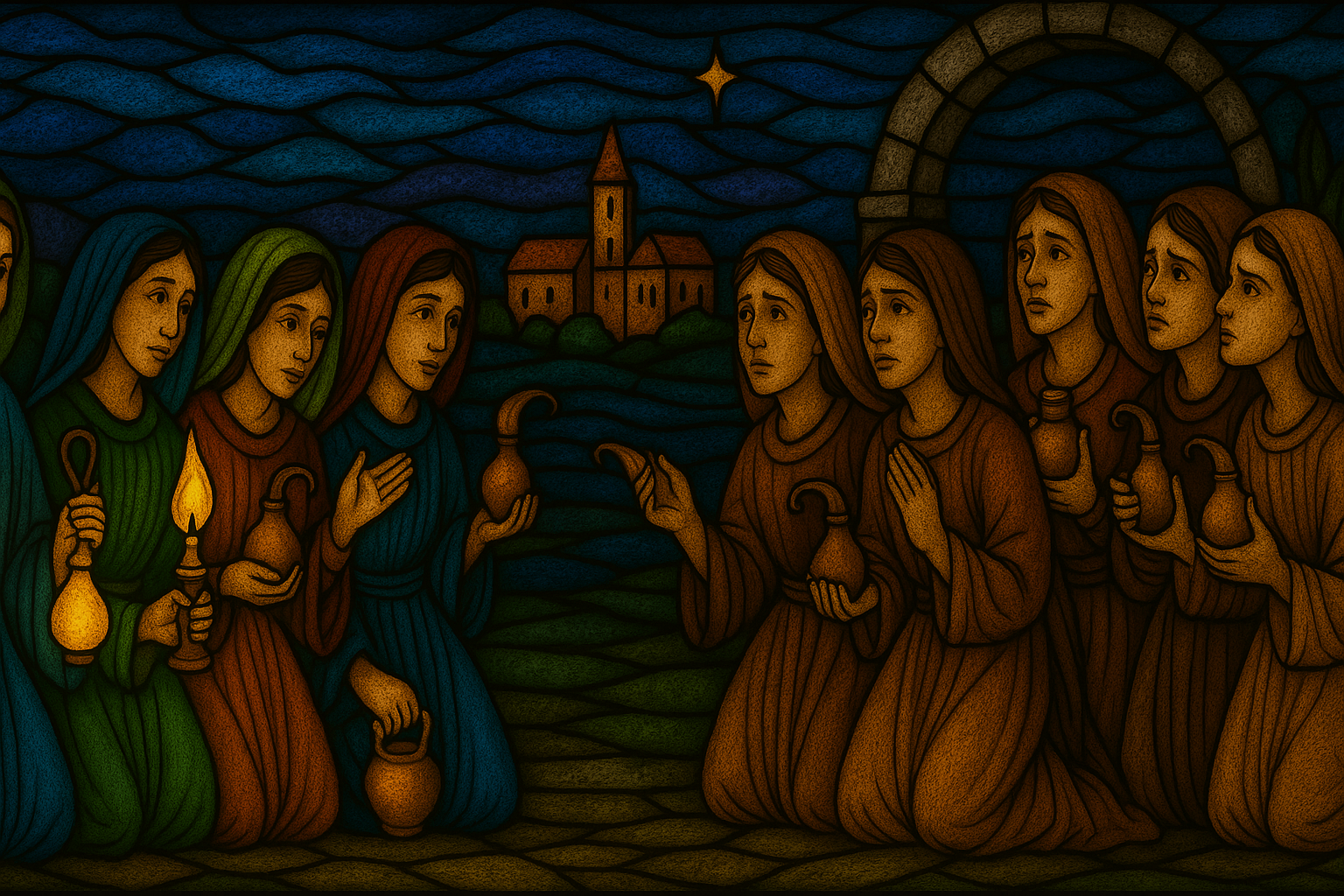
I suppose this is why the parable we just read as our Gospel is one of the least mentioned and least preached about teachings. Jesus introduces us to ten young women, preparing for marriage. They are eagerly anticipating the coming of the bridegroom. But then we heard a glitch. The bridegroom is delayed.
Anyone who has ever been involved in planning a wedding knows that there is always something that goes awry. And this story is no different. There is a postponement. And so we read that these ten brides decide to rest, unwind, slow down, and slumber. But then, all of a sudden, the bridegroom arrives unexpectedly early. And here is where the crisis ensues. Five of the women have prepared ahead. They realized that at any moment they might be called upon to give an account of their actions. The other five find it easy to postpone any preparations. It’s not that the latter five are bad, or even irresponsible. It is simply that they did not feel a sense of urgency. It was easier slumbering, putting off any decisions and actions until the bridegroom arrived. Well, you know the end of the story. When the five foolish maidens finally get their act together and respond to the situation, the door to the marriage service is closed. The moment to respond has passed them by.
The learning of this parable is quite simple and direct. We are being told to wake up. The moment is now, and you can’t postpone making up your mind. Your actions do count. They have transcendent significance.
The Romanian poet, Stefan Dorm, in one of his poignant poems written to the Romanian people, said: “I wanted to wake you up, but you are dreaming this merry nightmare so deeply.” Our merry nightmare is something from which we need to awaken. We need to wake up to accountability and urgency. Our actions do matter.
Which brings me to the fact that we are into Canvass Sunday. Now I don’t propose to tell you what to do about your pledge. That’s between you and God. But this much I will say. You don’t have to do it the same way you’ve always done it. You’ve been given the gift of freedom to choose. Why not write down some alternatives? And, second, remember that you are accountable for your pledge. It is true that the church has to live with what you pledge, but it’s also true that you have to live with it. And your pledge matters. It matters to God.
The third point is that there is a sense of urgency about what we do. I suggest you think of your pledge as your anal testament. There is a sign that I once saw outside of a church that has stuck with me. It seems to be appropriate in a time when we’ve all become trial watchers. It went this way: “If you were on trial for being a Christian, would they have enough evidence to convict you?”
If not now, when? if not here, where?
Amen
“What Ought I to Do?”
“What Ought I to Do?”
October 22, 1995
Scripture: Matthew 25: 1-13